
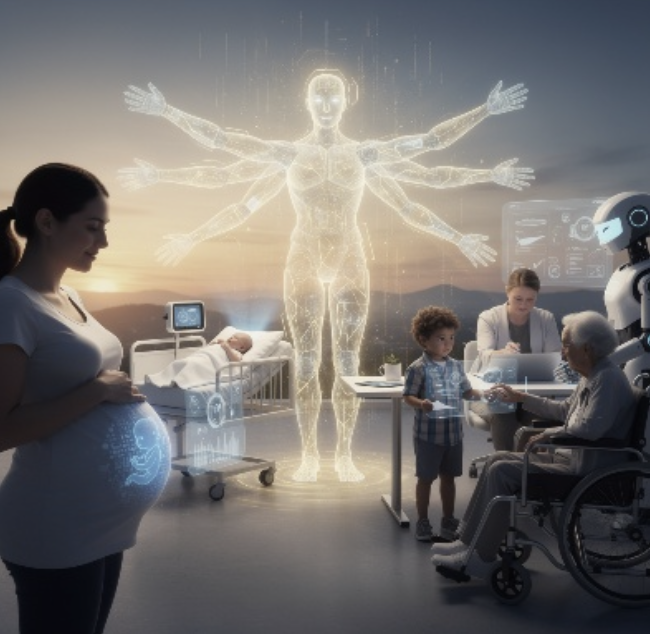
On Saturday 26th September 2026, amid constant news about Artificial Intelligence, Fr Hugh MacKenzie, priest at Westminster Cathedral and expert on the subject, travelled to Gidea Park to present a talk entitled “Catholic Teaching in the World of AI”. His talk drew richly on the recent encyclical letter of Pope Leo XIV which is titled 'Magnifica Humanitas: on safeguarding the human person in the time of artificial intelligence'. Pope Leo sets his encyclical in the context of the Social Doctrine of the Church, above all in the context of the value of human beings and the common good. It has to be borne in mind that, however many parallels may be drawn between AI and human beings, AI remains a tool, a medium for human activity. Fr Hugh informed us that the word 'danger' is used no less than thirteen times in the document. The issue with AI is how human beings misuse it. It can easily be used for profit and manipulation. Pope Leo points to the dignity, freedom and responsibility of the human person. Unlike AI tools human beings can know and can will. We can “give of ourselves”. This is a “spiritual”/”immaterial” reality, whereas “nothing in the AI world is immaterial”. AI, like all material, is an ordered, predictable, un-free, medium for this. With adequate oversight human beings can use AI for good, but there are also profound risks in its use, not least in allowing ‘bots’ to make up their own rules. When considering the global economy the central place of meaningful work for human beings, often neglected through abuse of human beings, is stressed. Man has gifts to develop and offer. There is also an emphasis on the real and potential use of AI in war, which is becoming normalised and dehumanised in our times. Basically, AI has no human heart to care for those in need, to welcome the migrants, to dialogue lovingly with those who do not share our views. True meaning in life is offered to human beings in the love of God, revealed in the heart of our Lord Jesus Christ.